Support Our Initiative
If you share our vision for the future of ISU, we would be honoured to receive your contribution.
Please contact us at staffreps_isu@riseup.net or use the contact form below.
We need your financial help
If you are interested in either buying a share (150€ and up) in the future cooperative model or donate, please show your interest by filling in the form below.
We need your partnerships
We would welcome collaborations with New and "Old" Space companies. If you are working for a company that is interested in collaborating with the new ISU through team projects, internships or research projects, please fill in the form below.
We need your organizational skills
If you are willing to contribute to the organization of ISU 40th Anniversary through ideas, contacts and on-site help, please fill in the form below.
We need the support of Global Faculty and Visiting Lecturers
If you have been teaching for ISU or would like to teach, mentor, supervise or propose new courses, please fill in the form. Your support is essential to the quality of the education and the state-of-the-art curricula of the programs.
We need your community building and engagement
The alumni network itself can become stronger by reconnecting different generations of graduates, creating professional communities of practice, sharing opportunities and knowledge, celebrating ISU achievements worldwide. Please fill in the form below if you are interested in contributing or organizing alumni events.
We need your experience
Alumni and Global Faculty can provide institutional wisdom and expertise by contributing to committees regarding strategic planning, governance reform discussions, risk assessment and long-term vision development. Please fill in the form below if you are interested in actively contributing to ISU governance through the participation in committees.
Questions and Answers
Yes, the accreditation is directly connected to the MSS of ISU in Strasbourg and provided by ASIIN e.V., a German based Accreditation Agency for Study Programs in Engineering, Informatics, Natural Sciences and Mathematics. ASIIN confirms that a study program meets a high quality standard. Another Master in another institution would require a new certification. Currently, it is not recognized as a public higher-education diploma. A partnership with the University of Strasbourg, as proposed in our project, could lead to this recognition.
For more than three decades, Strasbourg has been the heart of ISU's unique international educational model, bringing together students and professionals from around the world in one place for the Master program, and organizing the Southern Hemisphere Space Studies Program, the Space Studies Program with partner hosts in different countries every year, as well as the Executive Space Courses.
This multicultural, international environment is a defining characteristic of the ISU experience and cannot be replicated through a network of regional hubs, where participation would naturally become more geographically and culturally concentrated. When engineers, policymakers, entrepreneurs, and scientists from different background share a physical space, cultural assumptions are challenged spontaneously, informal diplomacy unfolds between formal sessions, ideas ignite, and alliances are built not only in structured projects but in unplanned conversations that continue long after graduation.
Preserving the central campus in Strasbourg ensures that not only the academic education of the MSS continues, in an international and intercultural environment, but that ISU carries on to provide the support to start-ups from founders all over the world through its incubator hosted on the ISU campus in Strasbourg. At the same time, the campus allows the continuation of its programs worldwide (SSP, SHSSP and ESC) by hosting the very ISU personnel and resident faculty in charge of contributing to the organization of these programs.
ISU in Strasbourg was registered as a non-profit Alsace-Moselle local law association in 1993, hereafter ISU Association. ISU Org was registered in 1987 in Massachusetts, USA. The President, trustees and governing members of ISU Association (based in Strasbourg) have consistently also been the President, directors and members of ISU Org since about 1995, as identified in the public database of the Commonwealth of Massachusetts. For instance, the meeting that took place every February in Strasbourg included the General Assemblies for both associations with the same participants.
The same is supported by ISU Org's tax filings. It is ISU Association (based in Strasbourg) that over the years filed the tax returns in the US for ISU Org, notably through ISU Strasbourg accountant, as it can be seen in the US public database of tax-filings for non-profit associations. Moreover, the ISU Org bylaws amendment of December 1993, available on the public database of the Commonwealth of Massachusetts, expressly states that one of the purposes of ISU Org is to support ISU in Alsace, France:
“Supporting an international institution called the International Space University Association established under Alsace Law.”
ISU Association (based in Strasbourg) has been consistently running the operations, organizing the different ISU programs, such as the MSS, SSP, SHSSP, ESCs, in collaboration with hosting partners and alumni, the research programs, the ISU start-ups incubator, the General Assemblies and committees meetings, and has been filing taxes for both entities. ISU Org employed the North-American Vice-President using ISU Association (based in Strasbourg) funds, and received small US grants.
The international trademark database maintained by WIPO indicates that the "International Space University" trademark is the intellectual property of ISU Association (based in Strasbourg) in several jurisdictions around the world, including the US, China, Australia, Russia, UK, France and the European Union.
According to the U.S. trademark database (USPTO) and the international trademark database (WIPO), the trademark "International Space University" has been registered on three occasions in the US:
- The first registration was filed in 1988 by the owner "International Space University Project" and was subsequently cancelled in 1994 pursuant to Section 8, which provides that a registration may be cancelled when the registrant fails to file an acceptable declaration of continued use.
- The second registration was filed in 2005 by the owner "International Space University Organization, Inc." and was cancelled in 2012, again pursuant to Section 8.
- The third registration was filed in 2018 by ISU Association (based in Strasbourg) and remains active to this day.
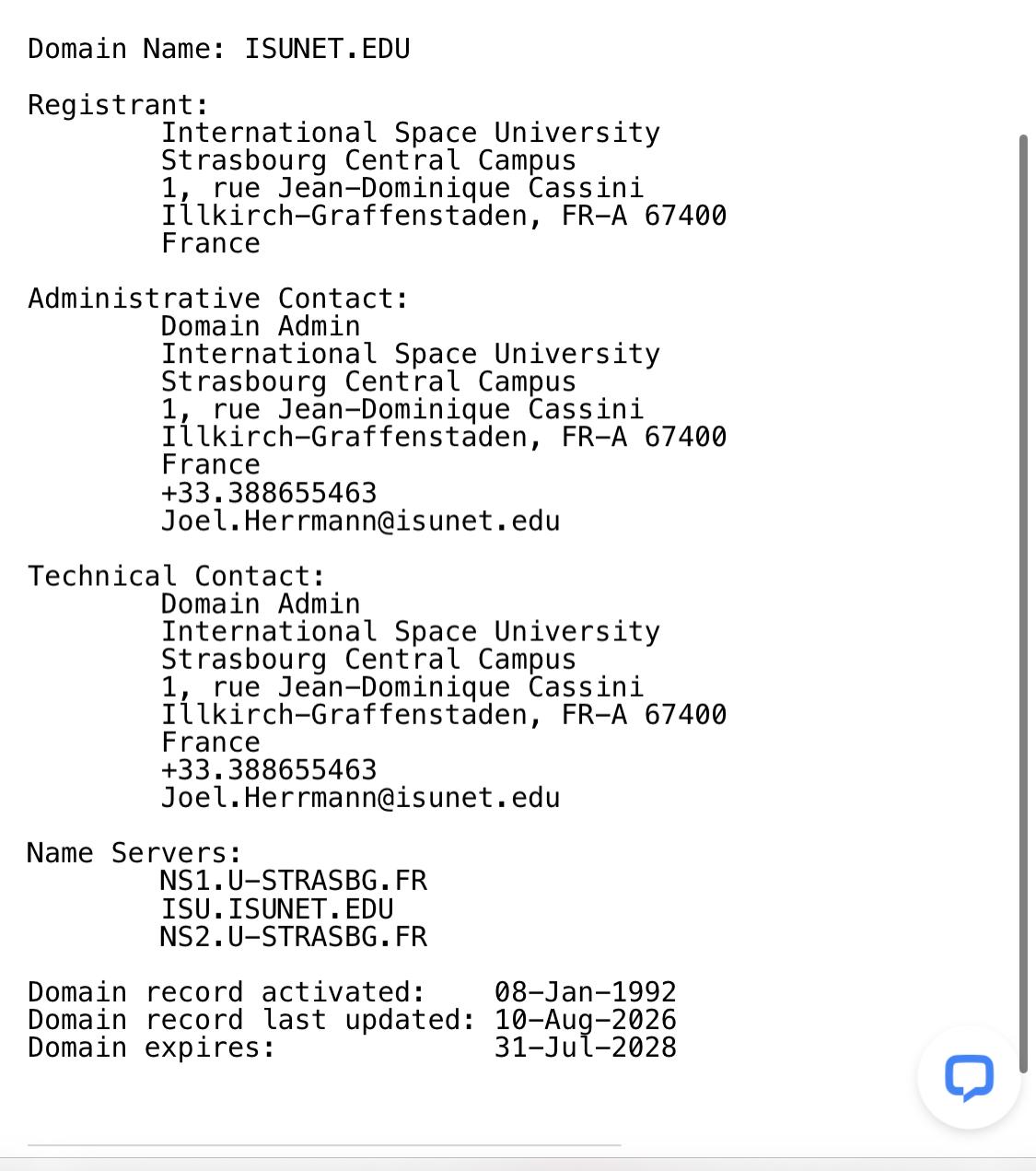
Currently, the isunet.edu domain belongs to ISU Association (in Strasbourg), as stated on the
EDUCAUSE Whois Lookup database. Historically, the domain was
first registered on 8 January 1992 and last updated on 10 August 2026 with an expiration date of 31 July 2028.
The .edu domain is a top-level domain used primarily by educational institutions in the United States. It is reserved for
post-secondary educational institutions that are institutionally accredited by an agency on the U.S. Department of Educations's list
of Nationally Recognized Accrediting Agencies. However, a certain number of non-U.S. institutions obtained .edu names before the strict U.S.
only policy took effect in 2001, as it is the case for ISU Association (in Strasbourg).
The 3I approach is the pedagogical philosophy at the heart of ISU. The International, Intercultural and Interdisciplinary model was developed to prepare future space professionals and leaders for a sector that inherently transcends national, cultural and disciplinary boundaries:
-
🚀International: students and faculty from different countries work together in an educational environment based on international cooperation.
🚀Intercultural: participants from different cultural, national and professional backgrounds learn to work effectively across different cultural backgrounds, perspectives and approaches to communication, leadership and decision-making.
🚀Interdisciplinary: space is taught as a complete system, combining science and engineering with medicine, business, management, policy, law, humanities, ethics, etc., reflecting the complex and multidisciplinary nature of space activities.
The 3I model therefore represents more than a pedagogical approach, it is a distinctive educational philosophy and institutional identity. It aims to develop professionals capable of moving beyond disciplinary and national boundaries and becoming effective leaders in an increasingly interconnected global space sector.
François Becker, former Professor at the University of Strasbourg ISU Dean between 1997 and 2004, and ISU Dean Emeritus, articulated ISU's distinctive International, Intercultural and Interdisciplinary (3I) educational model in his paper (as referenced in another 2025 paper ):
"F. Becker, Approach of International Space University to Space Education: ISU's Educational Model, ISU, April 2002"
The original model of the International Space University was conceived as an international, distributed and networked university,
with a central campus, that was to become Strasbourg, at its institutional and academic core providing a Master of Space Studies and in charge of
organizing a Space Studies Program among others, a North-American office, and a network of Affiliate Campuses located within
universities and research institutions around the world, as stated in the documents prepared in 2001 for the recognition of ISU as French higher education institution by François Becker, former Professor of the University of Strasbourg and ISU Dean between 1997 and 2004, and ISU Dean Emeritus. In a Times Higher Education article in 2000, ISU was described as having 24 Affiliate Campuses in 14 countries.
The Affiliate Campuses did not constitute an independent educational network operating separately from ISU, nor were they franchises authorized to independently deliver ISU's degree programs. They rather contributed to the programs by providing faculty, students, academic expertise, research capabilities, local institutional support and, in the case of the SSP, hosting facilities when the program was organized in their region. The relationship was therefore one of academic integration within a single ISU educational model: Strasbourg retained responsibility for the programs, while Affiliate Campuses enriched and extended them through their own academic communities and regional expertise.
The University of Hawai‘i provides a particularly clear example of how this model operated in practice. The Hawai‘i Research Center
for Futures Studies became an
ISU Affiliate Campus in 1996 . Its faculty and students participated in ISU's Master of Space Studies (MSS)
at the Strasbourg campus and in the Space Studies Program (SSP), which was hosted in different locations around the world. At the same
time, selected ISU MSS students came to the University of Hawai‘i for their internship programs. ISU and the University of Hawai‘i
also cooperated in research, training and outreach projects, including the development of multidisciplinary and multicultural educational material on space. The relationship therefore worked in both directions. University of Hawai‘i students also benefited from special admission arrangements and substantially reduced tuition at ISU, and several subsequently obtained ISU MSc degrees.
It has been suggested that ISU's Association (based in Strasbourg) economic model is outdated because it relies, in part, on public funding. This argument overlooks a fundamental reality of higher education. Around the world, a large majority of universities, whether public or private, benefit from public support, either directly through government funding and research grants or indirectly through tax incentives, scholarships, infrastructure, or partnerships with public institutions. Higher education is widely recognized as a public good that generates long-term economic, scientific, technological, and societal benefits extending far beyond the institutions themselves.
ISU Association (based in Strasbourg) is no exception. As an international, non-profit university dedicated to educating future leaders of the global space sector, its mission creates value not only for its students but also for governments, industry, research organizations, and society as a whole. The need for public support for ISU should therefore not be viewed as a weakness, but as a strategic investment in international cooperation, innovation, workforce development, and the continued competitiveness of the space sector.
The objective is not to depend exclusively on public funding, which was never the case (18% for the MSS/MSc and 20% for the SSP programs over the years), but to maintain a balanced and resilient financial model combining tuition fees, executive education, philanthropic donations, corporate partnerships, research projects, alumni contributions, and public support. This diversified approach reflects the funding model adopted by many internationally renowned universities and provides the stability required to pursue a long-term educational mission while remaining financially responsible.
It should be noted that despite the withdrawal of long-standing supporters, notably CNES, and the gradual reduction of contributions from the European Space Agency, combined with the delayed effects of the pandemic, the situation of the ISU Association (based in Strasbourg) prior to the current leadership was relatively favorable, with a surplus recorded for the post-COVID 2023–2024 fiscal year of 780.000€, according to public records. In addition, numerous other space agencies have continued to support ISU Association (based in Strasbourg) as clients, meaning they sponsored directly through fellowships the students and participants in ISU Association programs.
Over more than three decades, the ISU Association based in Strasbourg has built what ISU is today, through its staff, faculty, global faculty and volunteers. The continued success of ISU alumni illustrates the enduring relevance of this model. Graduates occupy leadership positions in space agencies, commercial space companies, international organizations, academia, and government around the world. Their careers demonstrate that employers continue to value ISU educated professionals who combine technical expertise with international experience, interdisciplinary thinking, leadership, and cross-cultural communication.
Rather than being obsolete, the ISU Association model (based in Strasbourg) needs to evolve while preserving its core strengths. Educational delivery can be modernized, partnerships expanded, new disciplines integrated, and financial sustainability reinforced. However, these innovations should strengthen, not replace, the institution's defining characteristics: a permanent international campus, a truly global student body, interdisciplinary education, and a commitment to international cooperation.
Without the on-site and future hybrid Master programs and only Space Studies Programs, as it would be the case with the regional hubs model without a central campus (not to mention the financial conundrum of having parallel SSPs organized by different hubs), the International Space University would not honor the "University" part of its name and would loose institutional credibility towards partnerships with other institutions, such as universities and other public and private entities, such as national space agencies or the space sector industry.
Without public funding and public and private clients, the International Space University cannot function, neither can regional hubs, unless the tuition fees are doubled. Furthermore, a diploma from a regional hub would not have the same credibility as a diploma issued by an institution with a renown central campus attached to it. Supporting our New ISU project is therefore about the preservation of an internationally recognized educational model that remains relevant today.
The future of the International Space University is not simply a choice between two organizations. It is a choice between two visions of what ISU should become. New ISU was created with a single objective: to preserve everything that has made ISU exceptional while equipping it to thrive for the next forty years.
For nearly four decades, ISU has stood apart because of a unique educational model: a permanent international campus in Strasbourg, complemented by educational programs delivered with partners around the world. This combination has brought together students, faculty, and professionals from more than one hundred countries to learn, collaborate, and build lifelong international networks. We believe this model remains ISU's greatest strength and should be preserved.
Our project therefore starts from a simple principle: evolution, not replacement. We seek to modernize governance, strengthen financial sustainability, diversify revenues, deepen partnerships with industry and public institutions, and give alumni a meaningful role in shaping the university's future. At the same time, we are committed to maintaining the international campus, the interdisciplinary philosophy, and the multicultural environment that have defined the ISU experience since its creation.
We also believe that the university should remain rooted in the community that built it. Faculty, staff, alumni, students, public authorities, industry partners, and host institutions should all have a voice in its future. A university with a global mission deserves governance that reflects the diversity of its international community.
New ISU is not about preserving the past for its own sake. It is about preserving what works while improving what must change. Financial discipline, transparency, accountability, academic excellence, and innovation are essential to our vision. But these improvements should reinforce ISU's identity, not transform it into a fundamentally different institution.
Thousands of alumni often describe ISU as a life-changing experience. They remember not only the education they received, but also the friendships, professional networks, and international perspective they gained by living and learning together. These are not accidental features of ISU, they are the essence of the institution that should be protected.
Supporting New ISU means supporting continuity, international cooperation, academic excellence, and a governance model that places the global ISU community at the center of the university's future. We believe this approach offers the strongest foundation for ensuring that future generations experience the same transformative education that has inspired the ISU community for nearly forty years.
We also believe that long-term financial sustainability requires a realistic and diversified economic model. A strategy that relies predominantly on Space Studies Programs as its principal source of revenue presents significant risks. These programs are, by nature, dependent on local host institutions, market demand, sponsorship, and regional economic conditions. Without a permanent academic campus generating year-round educational activity and without a balanced mix of revenue sources, including degree programs, executive education, corporate partnerships, philanthropy, alumni contributions, research projects, and appropriate public support, the financial resilience of the institution would be substantially reduced.
Moreover, there is a financial reality that is not sufficiently addressed by the multiple hubs model. Indeed, multiplying regional hubs may lack economic viability and educational coherence. Rather than creating complementary opportunities, hubs offering similar programs could ultimately compete with one another for the same pool of participants, faculty and sponsors. This internal competition could weaken enrolment, dilute resources, reduce the overall impact of each program, and weaken the economic model for all hubs.
Last but not least, a multiple hubs model risks undermining the very essence of the International Space University, and making the experience transactional rather than transformational. ISU's greatest strength has never been simply delivering educational programs in different countries. It has been bringing people from every continent together in one truly international academic community. A network of regional hubs would naturally attract participants primarily from their surrounding regions, resulting in cohorts that are less geographically and culturally diverse. Each hub might provide excellent education, it would be difficult to reproduce the exceptional level of international interaction, intercultural dialogue, and global networking that has defined the ISU experience for nearly four decades.
In our view, the future of ISU should therefore build upon the model that has proven successful: a permanent international campus serving as the heart of the institution, complemented by global partnerships and programs hosted around the world, preserving the financial resilience and the unique international identity that have made ISU one of the world's most distinctive institutions for space education.
We received many requests to clarify the timeline that led to the liquidation of ISU, and to provide more details. For the sake of transparency, please find below a factual timeline:
- 29 August 2025: The President since September 2024, John Wensveen, announced the plan for the dismissal of 6 staff members with the approval of the Board of Trustees: the person in charge of the ISU library, the person in charge of organizing the Executive Space Courses, the person in charge of organizing the SSP and SHSSP, the person in charge of the SSP and Master admissions, a Space Science Professor, and an HR assistant.
-
19 September 2025: Elected staff representatives sent a signed letter to the Board of Trustees expressing concerns that the proposed workforce reductions would undermine ISU's future revenue-generating capacity. The staff representatives never received a response. In addition, the letter mentions that since the appointment of the new management, ISU’s finances had suffered a major setback, with approximately €1.1 million in additional operational expenses according to documents presented to the staff representatives.
The letter also mentions that external contractors were hired and three recruitments had recently taken place or were currently underway, although it appeared that the dismissals were already discussed as early as June, namely a position for IT technician, Executive assistant, and the Executive Vice-President (William Muldoon) who started working at ISU on 1 September 2025, while a plan for collective dismissals was underway, and a COO (Joël Herrmann) was already in charge of daily operations. -
October 2025: In the Social-Economic Council (SEC) meetings with the staff representatives, ISU President and SEC President by delegation stated that the financial details would be kept confidential, although under French labor law there is an obligation to justify any collective dismissal with detailed and verifiable financial statements that show substantial and lasting financial losses (L.1233-3 du Code du travail).
In particular, under French labor law, the staff representatives have the obligation to provide a review/opinion (avis) within 30 days (Article L1233-8) on whether the dismissal plan is justified, based on detailed financial data. However, the economic grounds invoked (declining activity and financial difficulties) were not substantiated by the production of balance sheets, profit and loss accounts for the 2024/2025 financial year, the forecast financial statements and cash flow projections, or other supporting financial statements. Furthermore, the anticipated savings resulting from the proposed redundancies were not quantified and no detailed financial analysis of alternatives to the proposed redundancies, as requested by French labor law, were presented. The staff representatives were thus unable to provide a review or opinion on the dismissal plan. -
24 November 2025: Three staff members were dismissed: the person in charge of the library, the person in charge of the Executive Space Courses and an HR assistant. The other three staff members (in charge of the SSP, in charge of admissions and a Space Science Professor) were all staff representatives and as such under protected status. The authorization of the Work Inspector, based on detailed financial statements that were not provided, would have been necessary to dismiss these staff members. These three staff members were regularly reminded over a period of 9 months that they were still considered for dismissal.
Immediatley after the dismissal of the person in charge of the Executive Space Courses another person was hired for replacement, although French labor law (Article L.1233-45) states that an employee dismissed for economic reasons benefits from a priority for re-employment during one year. - 12 January 2026: The CARE committee, in charge of advising on faculty hiring and dismissal as described in the Academic handbook, was abolished by ISU President, John Wensveen.
-
26 February 2026: During the annual General Assembly at the central campus in Strasbourg, the ISU Association by-laws were amended, in accordance with a proposal by the ISU President, John Wensveen, and approved by the BoT, introducing significant changes to the University's governance structure, including the relationship between the Board of Trustees and the wider membership, as well as the role of the Academic Council. In particular, the governing members (approximately 40) were removed. The Academic Council role and independence were restricted, with the approval of the ISU president for all meetings and type of attendees as stated in the original draft submitted on 26 January 2026.
During the General Assembly, the Chairman of the Board of Trustees, Chris Sallaberger, only allowed on-site secret voting together with a proxy possibility of a maximum of 5 proxies per governing member attending on site. There were only three governing members present, apart from the Board of Trustees.
The bylaws of the ISU Association are available on the public database of the Alsace-Moselle associations. The bylaws voted on 26 February 2026 are not accessible yet, however were officially filed, according to the Illkirch-Graffenstaden judicial Court, and will be available in the coming weeks. - 26 February 2026: The Auditing firm, RSM France, issued the publicly available annual financial report, recording a deficit of €115,291 for the financial year 2024/2025 (1 September 2024 to 31 August 2025), and a cash flow in September 2025 of €1.93 million.
- 3 March 2026: The ISU President, John Wensveen, issued a fundraising appeal to the global ISU community seeking €1.5 million in scholarship funding.
- 6 March 2026: The Auditing firm, RSM France, issued a financial warning to the ISU management and in April to the judicial Court in Strasbourg. At this point, the Court did not appoint an administrator, since it is only done in the context of a safeguard procedure and no safeguard procedure was requested by the ISU management. Consequently, no legal constrains were imposed neither on the ISU president nor on the Board of Trustees, who were able to continue to administrate ISU.
-
31 March 2026: Bob Richards and Peter Diamandis filed documents to the registry of the Secretary of the Commonwealth of Massachusetts regarding the International Space University Org, Inc. (ISU Org), signed as the "sole surviving Permanent Members", in order to claim the presidency of ISU Org, although the status of Permanent Members was abolished by an amendment adopted in December 1993 and recorded in January 1994 in the same registry.
Furthermore, according to the publicly available documents only two persons voted, namely Bob Richards and Peter Diamandis, which does not constitute the two-thirds majority required by the ISU Org bylaws and by law (Massachusetts General Laws, Chapter 180, Section 7). The 2025 Annual Report in the publicly available registry, filed on 28 January 2026 and not contested, identifies three directors in addition to the President (John Wensveen), the Vice President (William Muldoon), and the Treasurer (Silvio Sandrone), all serving until February 2027. There may also be additional members, including, according to established practice, the governing members of the ISU Association. In any event, the two-thirds majority required for three directors, plus the two persons presenting themselves as members in March 2026 (Bob Richards and Peter Diamandis), amounts to 2/3 × 5 = 4 votes.
In addition, the filing seeks to amend bylaws indicating that Articles 2, 3, 4, and 6 were amended. In particular, the December 1993 amendment expressly stating that one of the purposes of ISU Org is to support ISU in Alsace, France, was removed:
“Supporting an international institution called the International Space University Association established under Alsace Law.” - 31 March 2026: During a Space Café webinar hosted by SpaceWatch.Global, President Wensveen described ISU as being at "the most critical stage in our entire almost four decades of being alive." He announced a spending freeze, confirmed that ISU would not participate in the Space Symposium, and acknowledged that contingency plans, including the possible closure of the Strasbourg campus, were under consideration. At the same time, he presented the "Moonshot 2030" vision, outlining ambitions for global expansion through hubs on every continent.
- April 2026: A Notice of Rescission of the trademark "International Space University" was sent by ISU Org to the ISU management of the central campus in Strasbourg.
- 9 May 2026: The internet domain isu.global was registered.
- May 2026: An alternative Space Studies Program was proposed by Bob Richards and Juan de Dalmau, former ISU President, to be held in July/August 2026 in Strasbourg and Barcelona during four weeks. The Eurometropolis of Strasbourg informed all parties that it would only financially support a common project that would include the ISU central campus management and staff.
- 2 June 2026: A safeguard procedure was requested by the ISU central campus management. The Strasbourg judicial Court appointed on June 10 an administrator to manage financial affaires of ISU central campus.
- 4 June 2026: ISU President, Jon Wensveen, resigned effective 30 June and did not attend the first Strasbourg judicial Court hearing on 8 June 2026. During this Court hearing, the judge clarified that ISU Org would not be part of the judicial procedure.
- 21 June 2026: The Strasbourg judicial Court appointed administrator to manage ISU affairs published a call for takeover offers with a deadline of 1 Juli 2026. Two offers were submitted, one from us, the staff representatives, proposing a cooperative model. However, due to the very short time given by the administrator to submit a proposal, we were unable to prepare a detailed project or to raise funds. We have no information about the second offer, except the fact that the vast majority of the staff would have been dismissed apart from two employees.
- 28 June 2026: A petition organized by us and alumni was launched to the wider ISU community in support of ensuring ISU long-term future and preserving its campus in Strasbourg. The initiative was received positively and signed by 1,085 alumni and ISU friends.
- 6 July 2026: During the court hearing at the Strasbourg judicial Court, the court-appointed administrator stated that neither of the two offers submitted provided sufficient guarantees to ensure the continuation of ISU’s operations. In addition, no funds were secured in the last month to safeguard the ISU Association. The administrator further indicated that the legal concerns raised by ISU Org regarding the "International Space University" trademark could jeopardize ISU Association existence. On this basis, the administrator requested that the Court order the liquidation of ISU Association.
- 7 July 2026: The Strasbourg judicial Court announced the decision to officially declare bankruptcy and liquidate ISU Association.
- 8 July 2026: The ISU Global website goes live.
- 11 July 2026: Our New ISU website goes live describing our updated cooperative model.
- 15 July 2026: The MSS/MSc students received their diploma issued by the ISU central campus in Strasbourg, including the MSc students.
- 17 July 2026: It was sadly the last day of work for all ISU management and staff. The Strasbourg central campus closes until further notice.
- 23 July 2026: The Strasbourg judicial Court published the liquidation jugement which was officially sent to the staff representatives. The reasons mentioned by the Court to justify the liquidation are among others that the request to initiate safeguard proceedings was made far too late to anticipate the difficulties and implement measures that could have enabled the continuation of the association’s activities; under ISU President's governance, relations with financial partners had significantly deteriorated and that all internal communication had been discontinued, including with the elected staff representatives; at the date of the hearing, no additional financial support had materialized to allow the continuation of ISU Association operations, nor the alternative Space Studies Program. In addition, a further difficulty arose as a result of the potential dispute by ISU Org which could challenge ISU Association’s use of the trademark.
Contact Form
The personal data collected through this form are protected under the European GDPR. We will only use them to contact you about the New ISU initiative and will share the information with no one unrelated to this project. You have the right to access, modify, and erase the data collected by writing to staffreps_isu@riseup.net. No automated decision-making system will be used.